Tudor Voices on the River Orwell
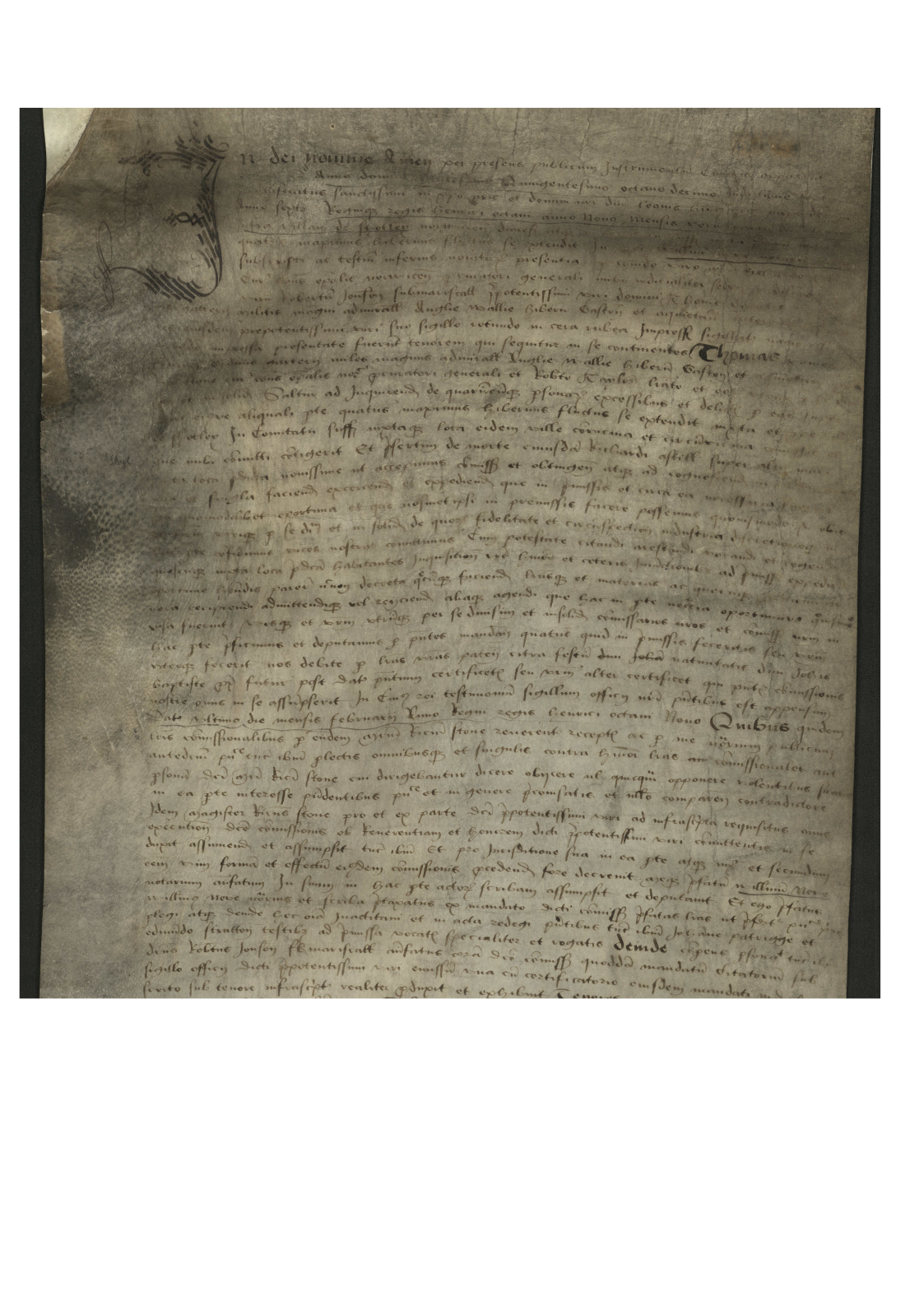

This project aims to investigate the voices of mariners from the Orwell Estuary in the early sixteenth century. It is based upon an unusual legal document: an admiralty inquiry into the accidental death of a young oyster-dragger, Richard Astill, from 1518. This source, which is held in Suffolk Archives, records eleven witnesses testifying to the circumstances of the accident, as a large ship coming up the Orwell rammed into Astill’s small boat and sent him overboard, whereupon he drowned. Although the inquiry was written in Latin, eight of the witness testimonies contain transcriptions of their original speech in Middle English. This grants us an unprecedented opportunity to hear the voices of everyday people living along the estuary in the Tudor period.
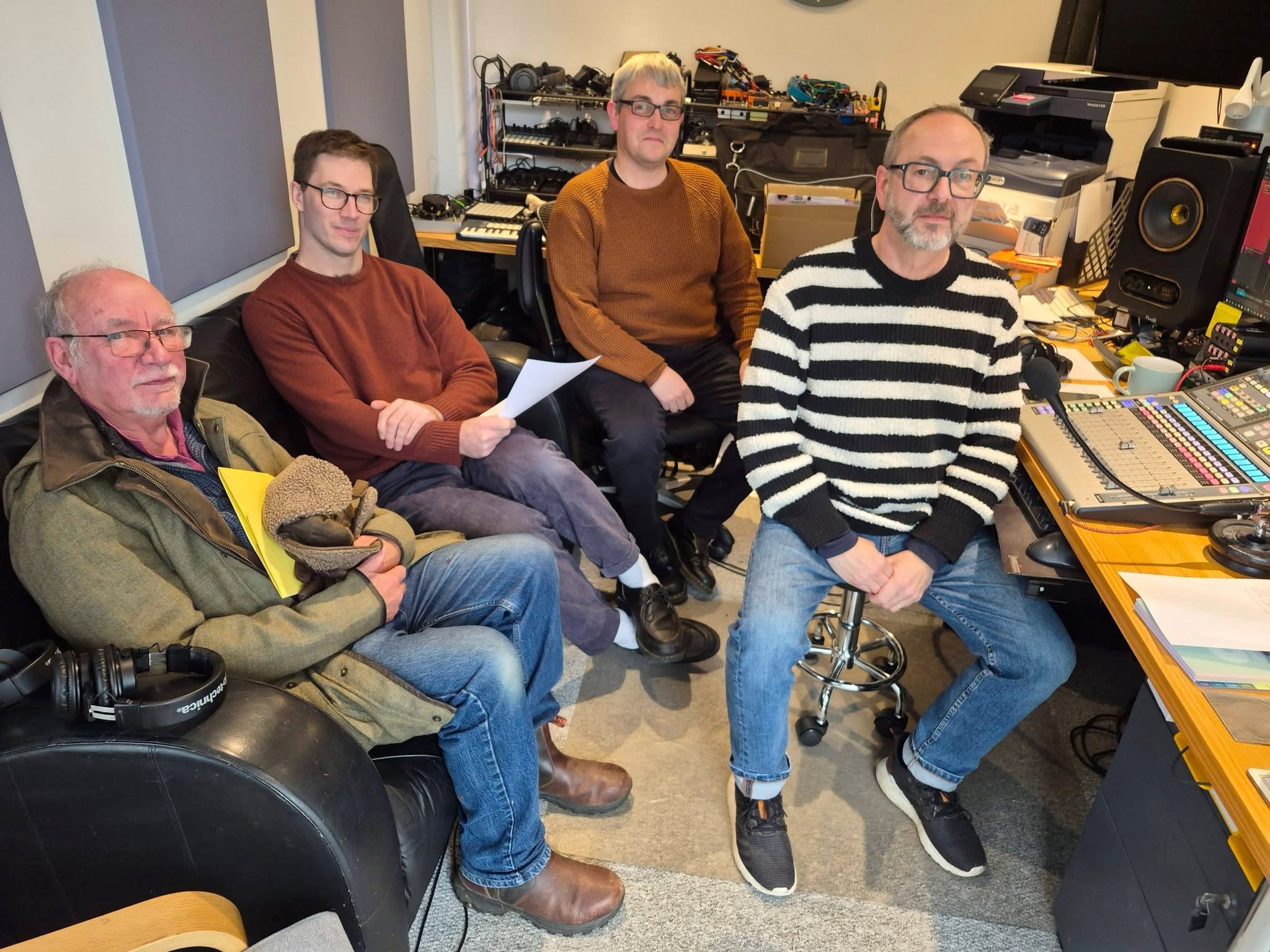
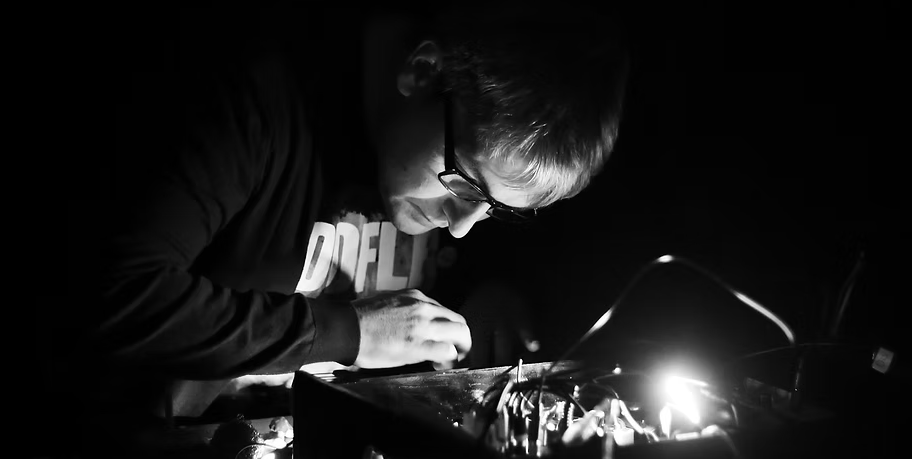
The project was developed by Dr Tom Johnson, a historian at Oxford University, who grew up in Ipswich. He has transcribed and translated the source, as part of his research into maritime communities in late-medieval Suffolk, and provided the contextual information for the source. Working with Matt Shenton, a sound artist living and working on the Shotley Peninsula, they developed a project to record the witness testimonies – in both Middle English and modern translations – and make them available online. Matt enlisted volunteers, wrote scripts, and organized the recordings at Silent Stage studio in Shotley; he has also made a sound piece drawing on the testimonies and his own field recordings. The project was funded by the British Academy.
We are grateful to all of the ‘witnesses’ who volunteered to record the testimonies:
Notary read by Simon Hooton
William Short read by Simon Pearce
John Amurrey read by Derek Davis
John James by Peter Glading
Thomas Branston read by Matthew Shenton
Hugh Page read by Christophe Spiers
John Swetman read by John Block

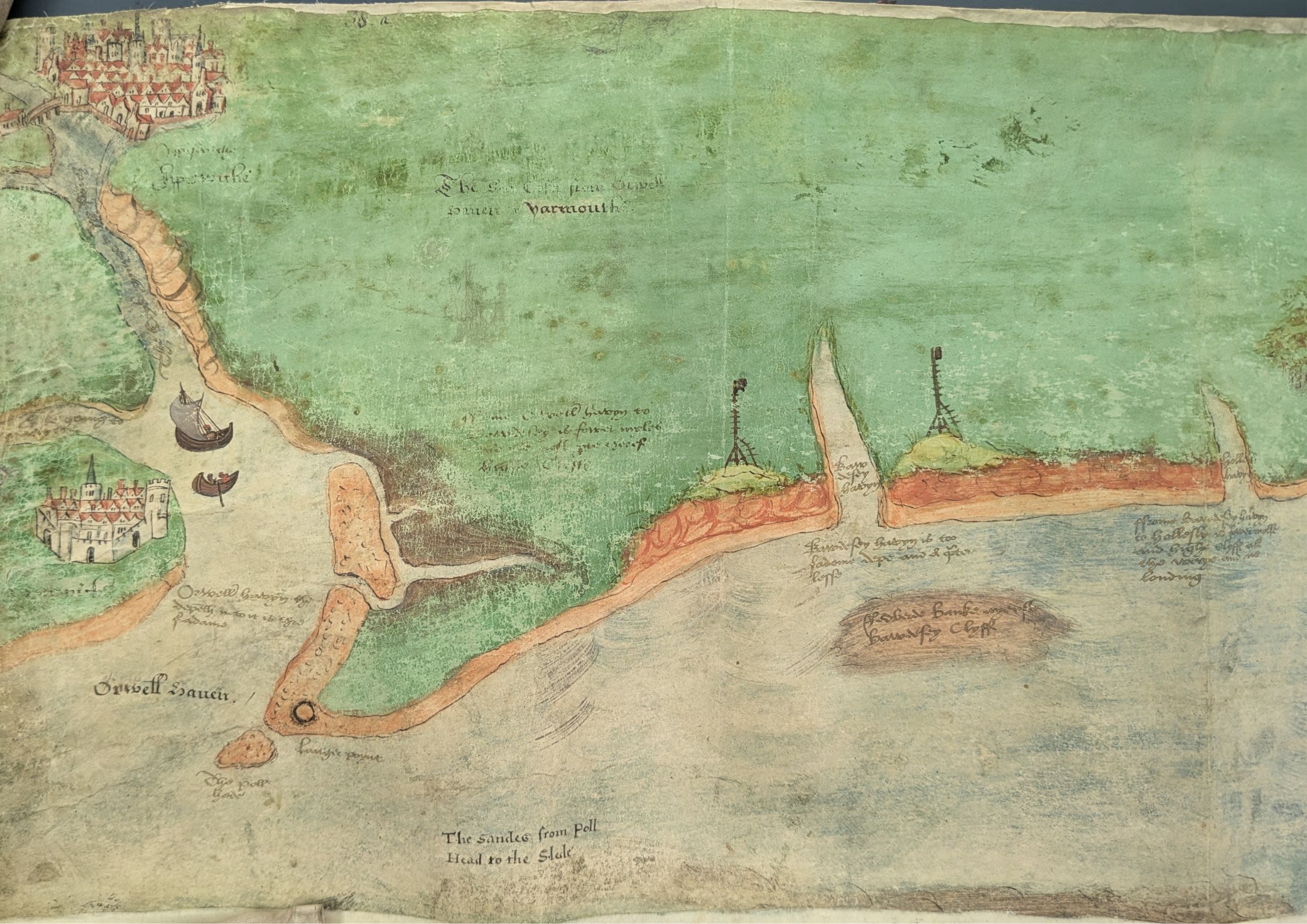
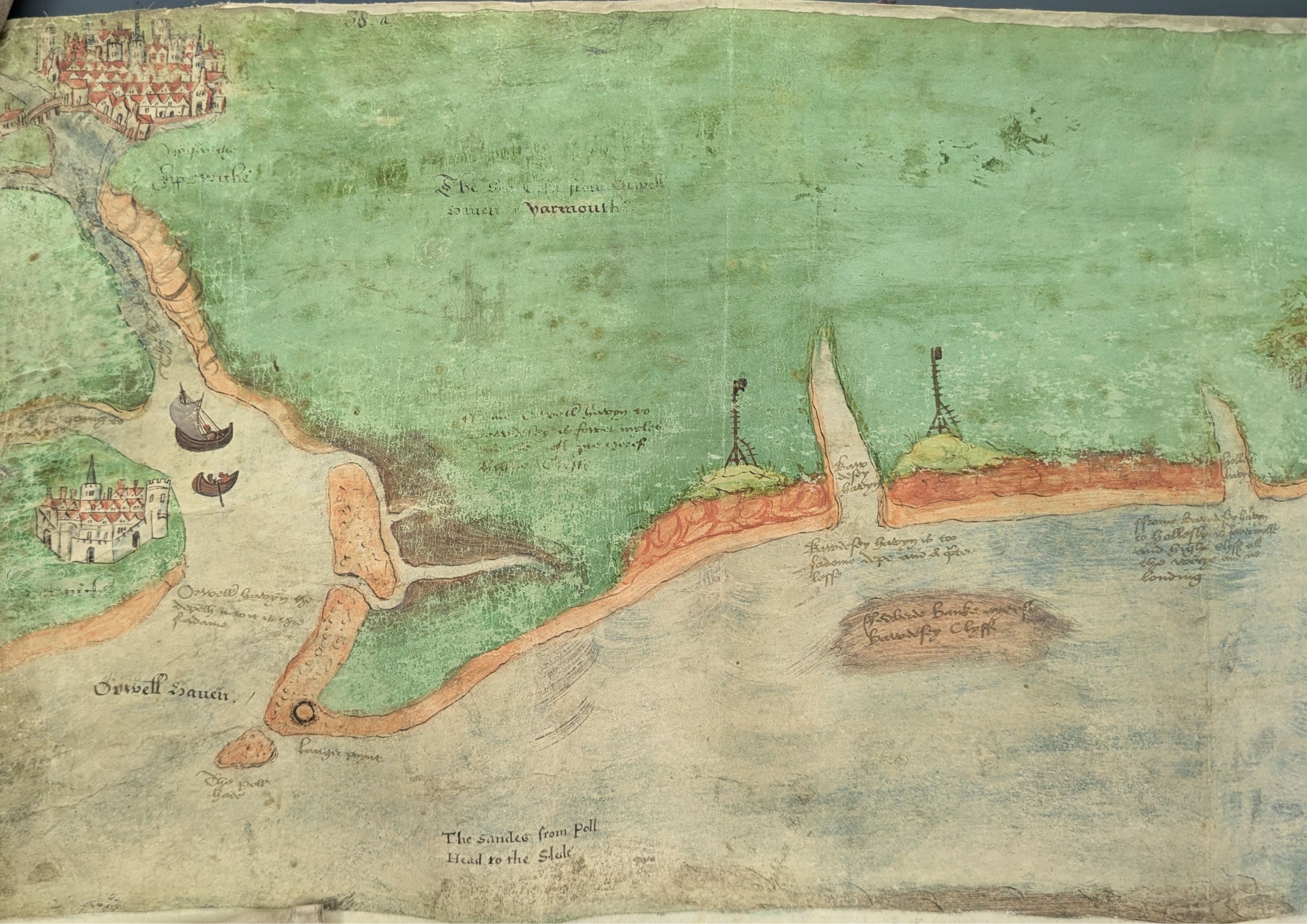
British Library, Cotton Augustus I, i, 58. Dates to 1539.
British Library, Cotton Augustus I, i, 58. Dates 1539.
The Incident
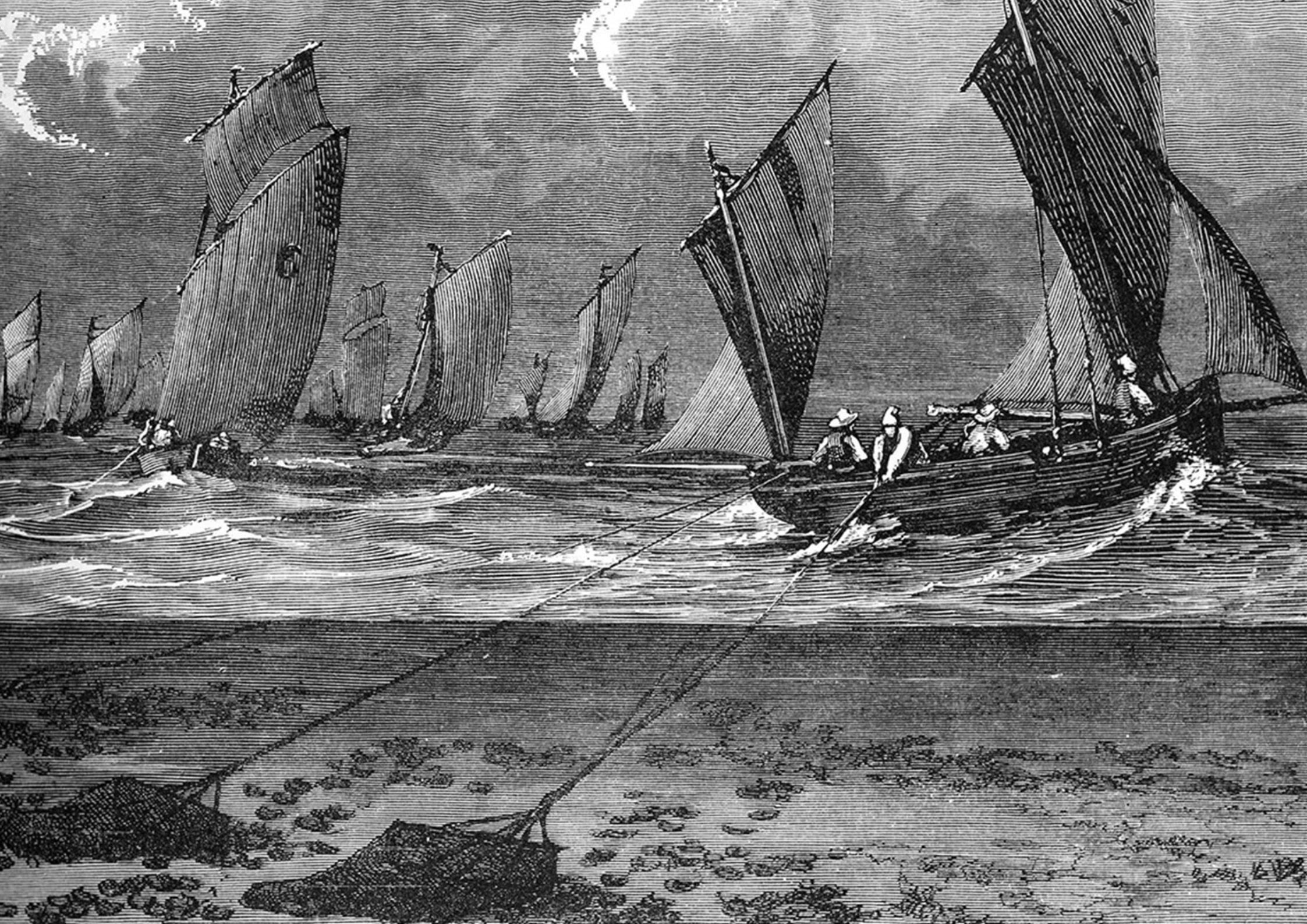
On the first Thursday of Clean Lent – the 25th February 1518 – Richard Astill and William Shorte were dragging for oysters in the waters off Harwich – probably at the mouth of the Orwell round the Shotley peninsula. Meanwhile, a ship called the John Evangelist, belonging to a wealthy local man named Edward Redde, was setting off from Harwich up the Orwell towards Ipswich. According to William Shorte, the two of them saw the ship when it was still some way off up the river (although Richard mistook it for a different ship) and made their way upstream to a place near Woolverstone. Here they cast their drag-nets again, and waited.
By all accounts, the weather that day was terrible. There was a great wind, blowing so hard that it was threatening to take the masts off ships. To make matters worse, just as the John Evangelist was coming up the river, the tide was falling to its lowest ebb. The Orwell, then as now, had a very wide tidal range. At low tide, the channel is narrow, and for a large ship like the John Evangelist, with a deep draught, there was little possibility for manouvering away from the centre without putting the ship in danger.
William and Richard hauled up their drag nets. At this point they could see John Evangelist at Pin Mill, less than a mile downstream. But then, in a curious detail, they gave a little ride to a minstrel who ‘desired to go on the water, sporting him for his pleasure’, and set him back to land at Woolverstone. Then they rowed back out into the channel to drag yet again. By now the weather had become even worse, and the wind was blowing their boat over to one side. The John Evangelist was heading straight towards them, now only a short distance away. Richard and William could hear the mariners onboard shouting something to them, but the wind was too strong for them to make out the words.
Hugh Page, another witness, was in a boat further downstream nearer to the great ship, but he was able to row to safety, apparently with little difficulty. William Shorte then heard the mariners of the John Evangelist were shouting to he and Richard to get out of the way, and that they would reimburse them if they destroyed their drag nets. The larger ship was careering upstream in the strong winds, and could not change its course. William told Richard to cut the drag rope, which was anchoring their small boat crosswise in the middle of the river – he could not do it himself because Richard was at the same end as the rope.
But, as William put it, ‘Richard looked up and did nothing’. At last, he realized the danger and shouted to William for help. William looked around for his knife – Richard had taken it earlier to shill oysters – but now neither of them could find it. Paralyzed by fear, perhaps, Richard still made no move as the John Evangelist got closer. The anchor palm (the flat side of the pointed edges of the flukes) of the ship ‘took the said boat by the shrouds and so the same boat sank. Both of them were cast into the water. William was pulled out by Thomas Branston, another oyster-dragger in the water nearby. Richard Astill was drowned.
Social Context: Maritime Communities on the Orwell Estuary
Richard Astill himself must remain something of a mystery. He is described at various points in the testimonies as a ‘maraner’. He was probably a young man – when he died, he was in a boat with his mate, William Shorte, who was 21 years old, according to his own deposition. We may also guess that like Shorte, he was from Woolverstone, then as now a village on the banks of the Orwell estuary, or perhaps from Shotley, where the inquiry was held. There are unfortunately few surviving records that might detail his economic or social background, but given his occupation, it seems likely that he was of relatively humble status.
February represented a lull in the major eastern fishing seasons for sprats and herring, which may explain why Astill and Shorte were dragging for oysters. At low tide, shellfish were gleaned by the very poor for subsistence. The fact that Astill and Short had a boat and fishing gear suggests that they had some means; but on the other hand, the ready availability of oysters meant that they were of quite low value – a few years before, a set of financial accounts from Suffolk reveals that one thousand oysters cost just fifteen pence.
The Will of Thomas Branston
Thomas Branston, the oyster-dragger who pulled Shorte out of the water. He died in 1531, ‘loved by God’. Although he was much older than Astill, being about 50 at the time of the inquiry, his will reveals something of the household of a village fisherman of low- to middling-status by the end of his life. Thomas was able to leave his wife Alice a house and make a fairly substantial donation of £1 to the church of Woolverstone for a new bell. He seems to have died without any children of his own: he gave a mark (two thirds of a pound) to each of John Freelove’s unmarried sons.
Interestingly, he also left three people exactly the same bequest, probably in charitable alms: a ewe, a lamb, and a shilling. The first two recipients were named Robert Brook and John Cove, but the third, interestingly, was left to ‘a lytyll mother’, suggesting perhaps that he intended the gift to go to an unmarried or widowed woman with children to support. If this interpretation is correct, then it tells us something of how Branston – and perhaps other village fishermen – might have regarded their own status: not wealthy, certainly, but respectably distant from true poverty. One of the witnesses to Thomas’s will was Nicholas Suell, one of the other Woolverstone fishermen who testified to the Astill inquiry in 1518. Rural communities were tight-knit in this period, and maritime communities – with their distinctive forms of expertise and working patterns – perhaps even more so.

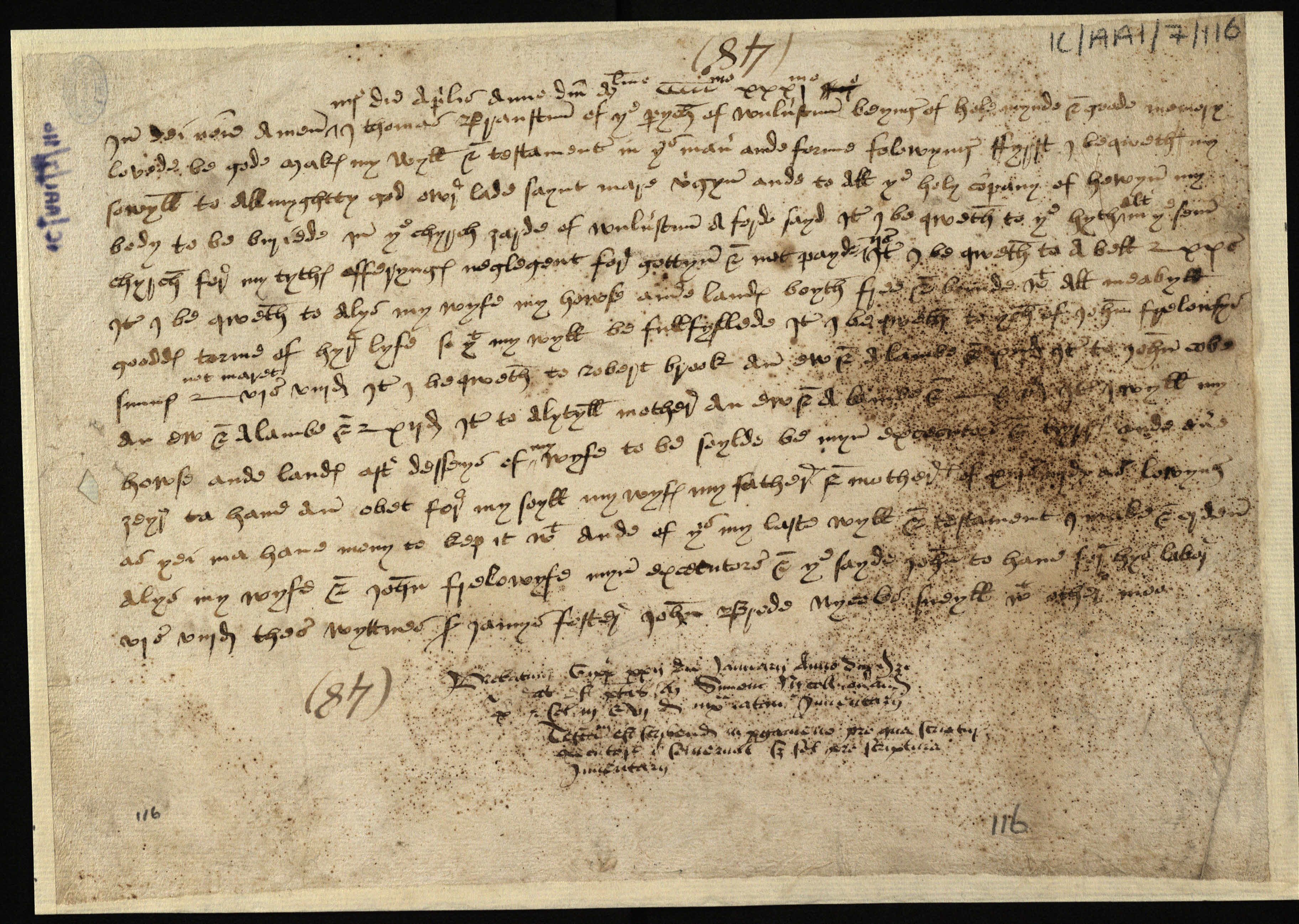
Original will of Thomas Branston of Woolverstone 1531 IC/AA1/7/116
Original will of Thomas Branston of Woolverstone 1531 IC/AA1/7/116
"Thursday after the first Sunday of Lent last passed by Wolverstone in the common river that flows towards Ipswich there, Richard Astill was drowned by his own imprudence and negligence, and by his own fault, because he did not avoid the ship when he saw it coming towards him, though he might easily have done so."
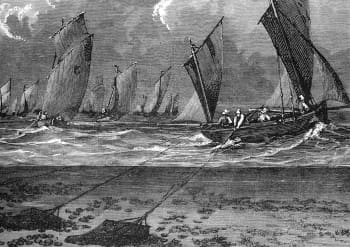
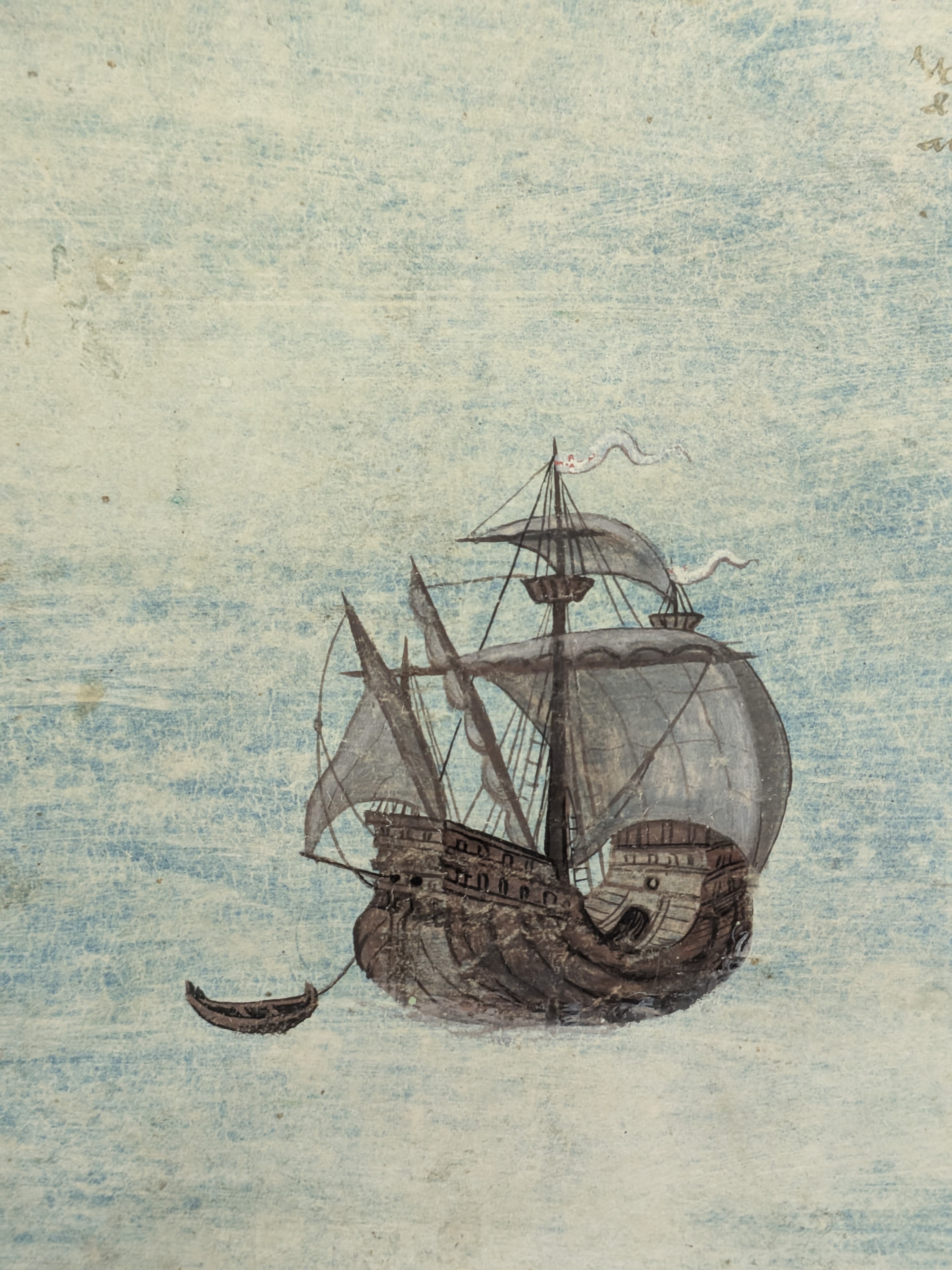
At the other end of the social spectrum, the other major figure in the inquiry is Master Edward Redde, of whom we can say a great deal more. He was a wealthy merchant of Harwich, who had married very strategically. In 1516, a rich shipowner named Thomas Wymbyll died, leaving a ship called The John Evangelist to his wife, Isolde (she may well have felt that the ship was hers by rights, given that it had once belonged to her father, John Woodlace). He left the rest of his ships to the town of Harwich, to be sold ‘so that the town may be better maintained’. Isolde Wymbyll was now a very attractive marriage prospect. She had a son, Thomas, who was not of full age, a ship, and a considerable quantity of money and properties in Harwich.
Edward Redde married Isolde soon afterwards and took possession of the full Woodlace and Wymbyll inheritance, much to the chagrin of her relatives. According to a lawsuit that they launched against him some years later, Redde had proceeded to sell off a lot of the ships and other goods – though not the John Evangelist – for the very large sum of £100. Then Isolde had died, and Edward refused to give her relatives the portion of her inheritance that they claimed to be owed. Although the outcome of this dispute is unclear, Redde did not stay in Harwich. Soon after the Astill dispute, he was elected as an alderman of Norwich, where a few years later would become mayor. This was an important political position, leading one of richest cities in England; he would enter negotiations with no lesser figure than Cardinal Wolsey, during the mediation of a local political dispute there between the city authorities and the cathedral priory. Redde was not a man to be trifled with.

The Legal Context
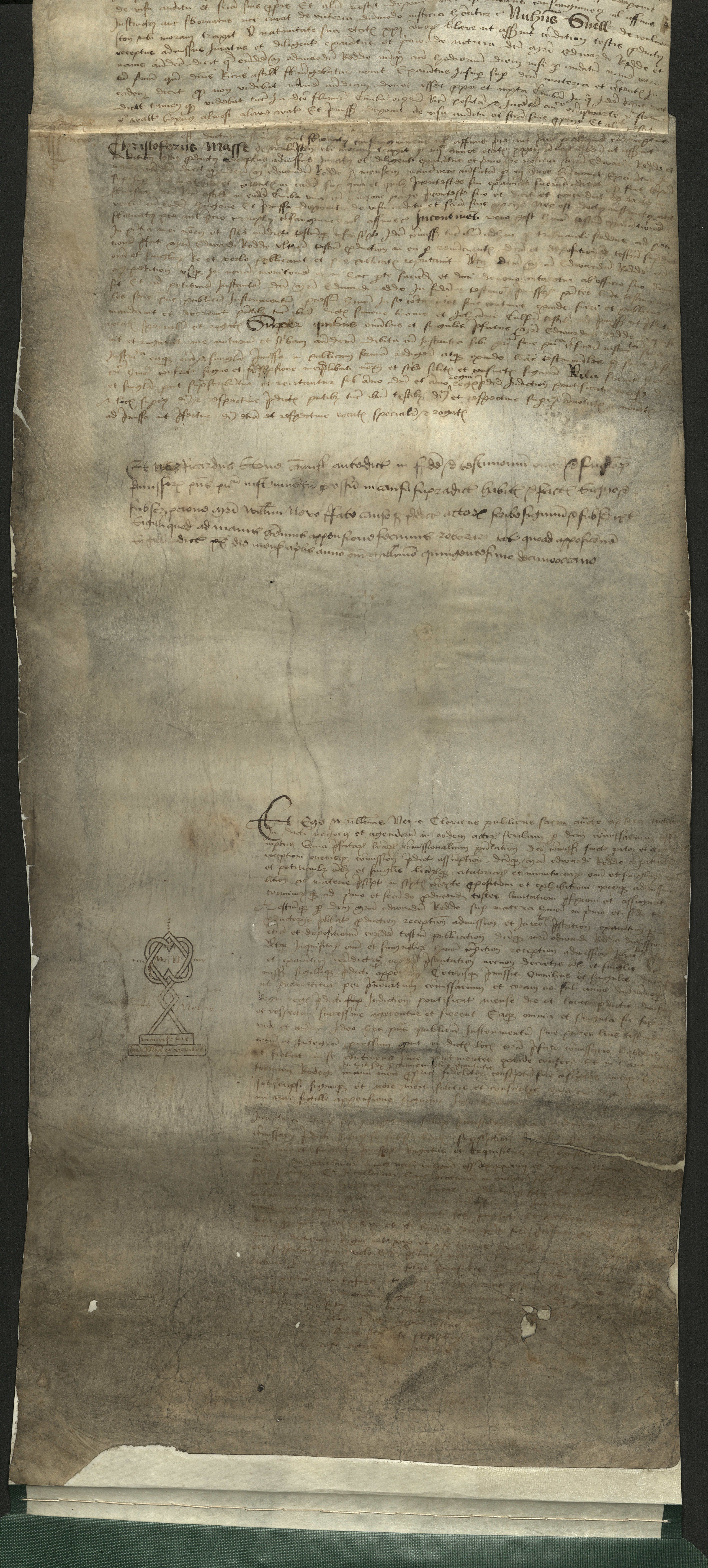
The inquiry was written by a notary public named William Neve. This is probably the same William Neve who taught grammar to the future archbishop of Canterbury, William Parker, in Norwich up until 1520 – he was remembered by Parker as a ‘gentle and mild’ man. Perhaps the same man or a relation was also a churchwarden of St. Stephen’s parish in Ipswich in the mid-1530s.
The proceedings initiated from a commission handed down under the authority of Thomas, Earl of Surrey, then Admiral of England, Wales, Ireland, Gascony, and Aquitaine, through his sub-marshal, Robert Johnson. In turn, Johnson sent letters of commission to Richard Stone, proctor general of the Consistory Court at Norwich, and Robert Naylor, ‘legate’, asking him to inquire into the death of Astill.[v] Stone accepted the commission and appointed Neve, and they appeared before Johnson, who gave them a certificate of the mandate to cite Edward Redde, the owner of the John Evangelist.
Neve then met with James Hille, one of the two bailiffs of Ipswich, and asked him to pass on the citation to Redde to appear at the correct time and place; this transaction was witnessed by the dean of Rocklond (a small deanery outside Norwich). When Redde appeared, some articles were drawn up covering the basic events of Astill’s death. Witnesses were assembled to give testimony, and were examined individually by the court. which sat at Shotley.
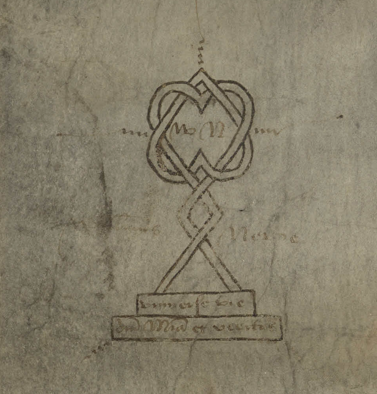
Subsequently a jury of 22 men was summoned and asked to give a verdict after hearing these testimonies, and an account of the death was drawn up. The jury delivered the verdict that Richard Astill’s death resulted from his own negligence because he failed to move out of the way of the ship. This verdict was proclaimed publicly in the vicinity of Shotley. Edward Redde, as the proprietor of the ship, was formally absolved of responsibility and then on the 1st April 1518, William Neve compiled the roll that now survives in the Hold, which he inscribed with his elaborate mark of authentication.

The judicial authority to hear post mortem inquisitions in the Middle Ages had been held the coroner since the early thirteenth century. Such inquisitions had two legal purposes: firstly, to make sure that murderers were held to account, and secondly, to judge and administer the ‘deodand’.[iii] In medieval law, a deodand was the object that was said to have ‘moved towards’ or caused the death of the victim (for example, the knife he was murdered with, or the rung of the ladder from which he fell). The jury of a coroner’s inquest decided what object was deodand, before giving it a monetary value. The object itself, or the equivalent amount of money, was then forfeit to the crown.
In practice, the right to deodand was often subcontracted to other authorities. Indeed, from the late fourteenth century, post mortem jurisdiction insofar as it affected maritime communities was exercised by the admiral. Two statutes introduced under Richard II to restrict the jurisdiction of the admiralty still obliged the courts to inquire into death and mayhem at sea and in tidal estuaries. In a tract ‘on the office of the admiralty’ – De Officio Admirallitatis – translated out of French into Latin by Thomas Rowghton sometime during the reign of Henry VI, the last article (number 50) outlined this duty more fully:
Item it is to be inquired whether anyone was murdered, drowned, or died on the sea because of any engines or artillery, anchor, cable, rope, or anything else pertaining to the ship, or by the motion of the ship; and of any such murder, drowning, or death, [the thing] is forfeit to the lord admiral, and ships or boats, if the drowning or death was caused by the motion of the same, are forfeit to the lord admiral.
This meant that a large variety of potentially hazardous objects that could be found aboard ships were liable to be forfeit to the admiral as deodand. Because the objects associated with shipping, and more importantly, the ships themselves, were often extremely expensive, the right of deodand ought to have been a valuable income for the admiralty jurisdiction. On the contrary, however, the few pieces of surviving evidence from admiralty courts in fifteenth-century East Anglia suggests that the post mortem jurisdiction possessed by the admiralty was not in fact applied very vigorously.
As early as the reign of King John, Ipswich had possessed coroner’s jurisdiction as part of its liberties granted from the Crown, and records survive from the middle of the fourteenth century.[vii] The borough was further granted admiralty jurisdiction by a charter of 1446, and this was clarified and ratified by charters of both Edward IV and Richard III.[viii] Whilst the town was certainly competent to hear post mortem inquisitions of mariners who died within its jurisdiction – which under the town’s admiralty jurisdiction included the Orwell estuary – there are only a few surviving records to show that the Ipswich authorities were indeed exercising this power.
All of these come from a court held in September 1513. The first recorded that William Orkneyman, on a voyage to Iceland on the Andrew of Ipswich, fell into the sea at a place called ‘Somiderser’ and drowned; the second that John Jenewey in the Anne went overboard ‘in partibus Selond in alto mare’ – on the high sea near Zeeland, off the coast of the Netherlands.[ix] These two cases were perhaps unusual in that both men were probably foreigners (from Orkney and Genoa respectively), and they died a long way from Ipswich, well beyond the geographical limits of the town’s jurisdiction. In neither case did the court attempt to identify a deodand.
The third case is more interesting. This was an inquest into the death of John Paret, a mariner, who was in the James, bound for Iceland. However, he fell into the sea ‘within the precinct and jurisdiction of this court, that is at Langer Point’, after the oar in his right hand caught in the water and he was dragged in with it.[x] Langer Point is still the name for the north side of the mouth of the Orwell’s estuary at Felixstowe – at the very limits of Ipswich’s admiralty jurisdiction, but considerably closer to the town. The fact that Paret’s death was said to be caused by the oar, though it was not given a monetary value, suggests the jury had been instructed to consider a deodand.
The town admiralty courts were interested in the causes of death at sea. William Orkneyman was said to have fallen overboard ob suam necligensiam, ‘on account of his own negligence’, while for John Jenewey it was his ‘improvidence’ – his inability to see what was going to happen next.[xi] Of course, it is impossible to know what actually happened in these cases, but it not implausible that either of these deaths could have been interpreted as falling under the specific provision made in the tract De Officio Admirallitatis, that declared ships forfeit if their ‘motion’ caused someone to fall overboard.[xii]
The ‘mystery’ of why the admiralty courts did not present these ships – or any of the abovementioned items – as deodand is actually relatively straightforward: the juries who made up admiralty courts were composed of masters and mariners, who had a clear interest in preventing shipping equipment and ships themselves from going to the burghal franchise-holders. Firstly, the jurors may have stood to gain personally from the testament of the deceased. As Sheila Sweetinburgh’s work on the wills of Kentish fishermen has shown, maritime communities ‘seem to have used their bequests of fishing items to initiate complex relationships, which they hoped would ensure the future well-being of their family and community.’
Secondly, in cases where the death took place at sea, the witnesses, whether merchants or mariners, had a direct stake in the profitability of the voyage. This would have been severely harmed by the forfeit of a valuable deodand. Although these men did not necessarily serve on the inquest jury itself, their knowledge of the circumstances was the only information the jury had at its disposal. It is thus hardly surprising that deodands were not regularly collected from maritime communities. The judicial reliance on the specialist knowledge of shipmasters and mariners to account for deaths at sea came with the hitch that those same shipmasters and mariners were not disposed to surrender the goods of their neighbours and business partners to the admiralty.
In the case of Richard Astill, a deodand was identified during the proceedings. He had fastened a drag-rope – wrongly, according to a couple of the witnesses – to the middle of his boat. With the difficult weather conditions and with the tide reaching its lowest ebb, this rope had fixed his boat so that it lay ‘overthwart’, or perpendicular to the flow of the Orwell. Throughout the tribunal, witnesses repeatedly emphasized Richard’s own negligence as the cause of his death: they were not going to testify that Edward Redde’s ship was to blame. Instead, the rope was attributed as the cause of Richard’s death. The Admiral declined to collect on his prize: the jury said that the rope was ‘rotten’ and ‘of no value’.











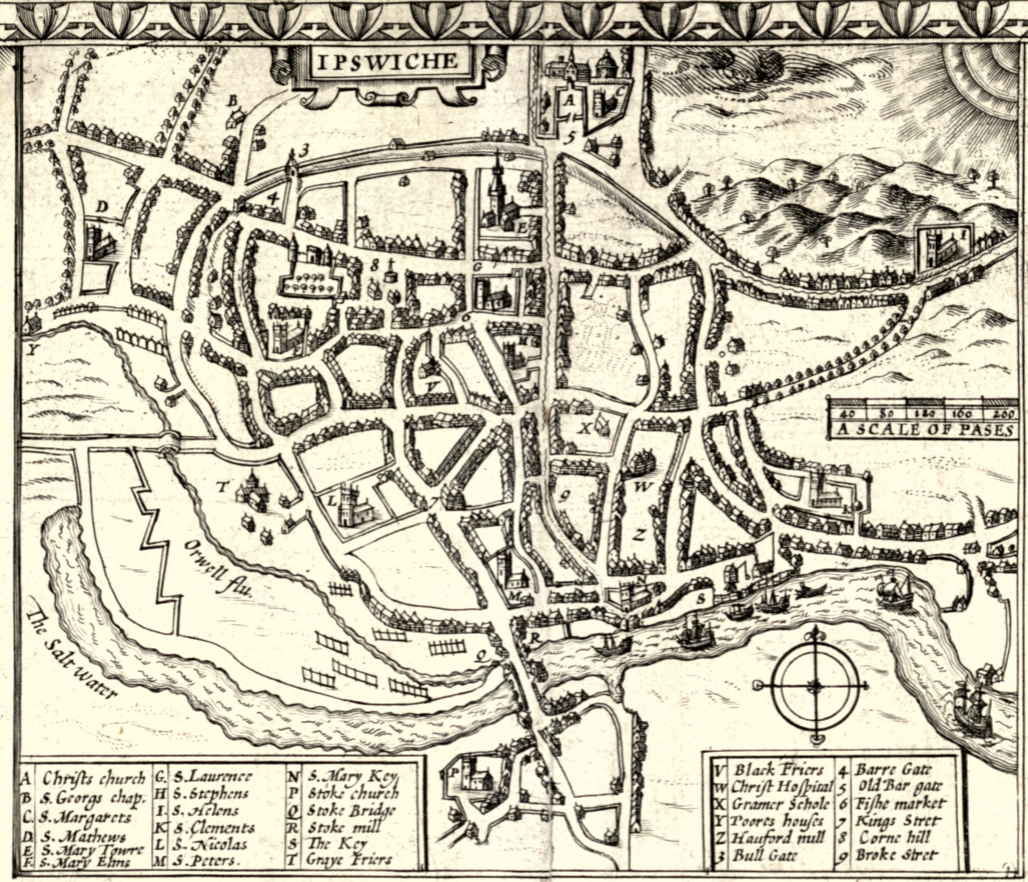
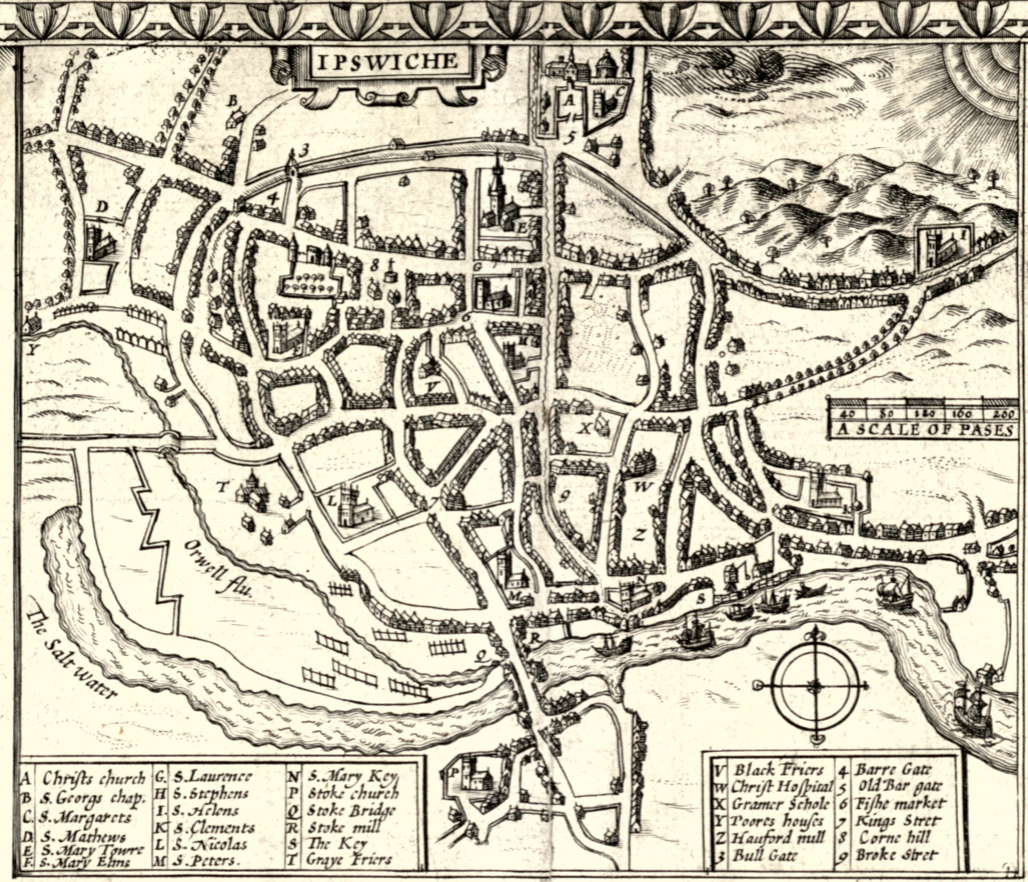
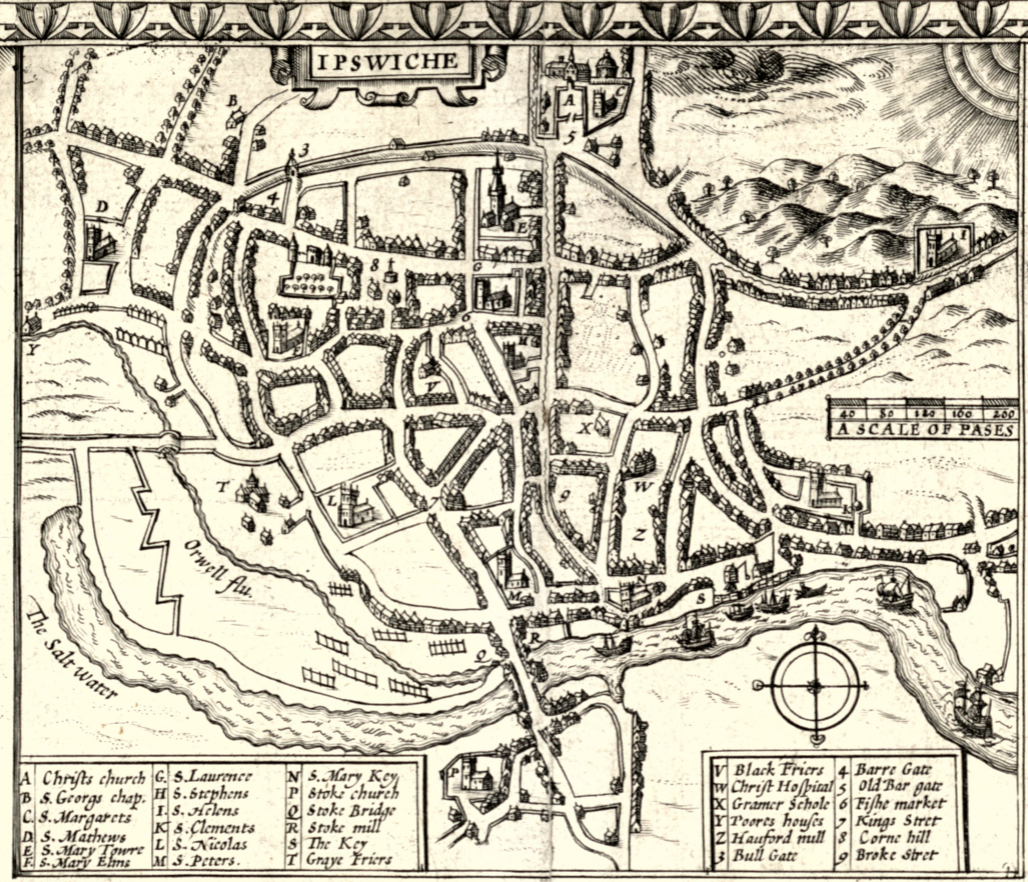
John Speed Map of Ipswich 1610
John Speed Map of Ipswich 1610
The Local Context
It is extremely unusual to find such an elaborate judicial inquisition from the Admiralty, and especially surprising given the humble circumstances of the deceased. The reason that the inquisition was taken – and that it was written out in such exhaustive detail – is probably related to local disputes between Ipswich and the royal officials of the Admiralty Court, which was enjoying a resurgence under Henry VIII. At this time, Ipswich’s admiralty liberties were perceived to be vulnerable by the Admiralty Court. A memorandum in the town’s register book, dated from August 16th 1493, records that the Earl of Oxford, then serving as Admiral of England, sent a servant to arrest a Breton ship ‘in the port of Orwell inside the liberty of the same town’.
The bailiffs, in response to this breach of the town’s jurisdiction, sent the charter of their liberties to Hedingham Castle, where the Earl’s men read it and related its contents to the Earl, whose vernacular response is recorded: ‘commend me to the bailiffs of Ipswich and say to them I will be friendly to them in this point and in all others contained in your charter. And I will do for them as a burgess and as one of you.’ William Pekynham, the archdeacon of Suffolk who was perhaps present to mediate, said something to the same effect. Though the Admiral was being ‘friendly’, it suggests that a generation before the Astill inquiry there was some latent tension between the central Admiralty Court and the liberty of admiralty jurisdiction exercised by the bailiffs of Ipswich. Clearly the town considered that the Earl’s not-quite-apology was worth writing down.

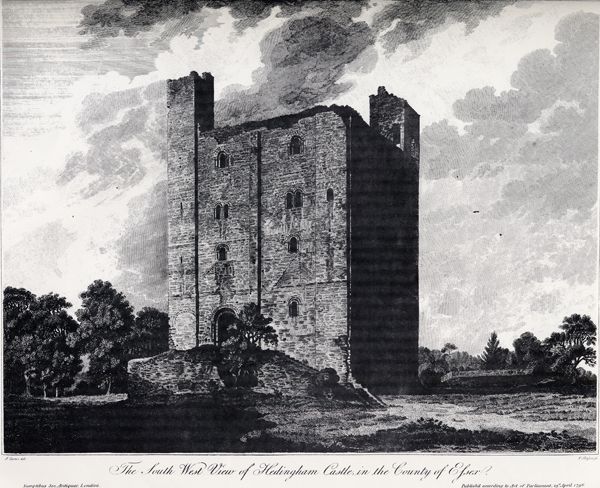
Reprint of a drawing of the Southwest view of Hedingham Castle in the County of Essex (original print drawn by H Emlyn, and published on 23 Apr 1796) K511/1179
Reprint of a drawing of the Southwest view of Hedingham Castle in the County of Essex (original print drawn by H Emlyn, and published on 23 Apr 1796) K511/1179
In the 1518 inquiry roll, references to the specific jurisdiction under which it was held are scant. The copy of the letters patent from the Lord Admiral mentions that once Richard Stone had accepted the mandate, ‘he determined to proceed from his jurisdiction in that part, near and according to all the forms and effects of the same commission.’ This is the only mention of any ‘jurisdiction’ in the whole document, which runs to over 8,000 words; it is also slightly unclear whose jurisdiction is being referred to. Clearly, the proceedings were carried out with the full knowledge of the bailiffs of Ipswich, one of whom was said to be present at the citation of Redde, and also later at the tribunal in Shotley – if not, perhaps, their hearty agreement.
The final, and possibly most important piece of surviving evidence in this respect is a set of letters patent issued by Henry VIII, confirming Ipswich’s admiralty jurisdiction. This document is dated to the 3rd March 1519, that is to say, less than a year after the inquiry into Astill’s death. Whilst its administrative function was to confirm the charter granted to the town by Edward IV, which has since been lost, it also reiterated the traditional boundary of the town’s admiralty jurisdiction at ‘Polleshead’, including the foreshore at high and low tides, and mentioning the right of wreck, the goods of suicides, and deodands. Although the charter does not provide conclusive evidence as to earlier events, it seems very likely, considering how quickly the burgesses sought to renew their admiralty charter, that the Astill inquiry had prompted them to renew the confirmation of their liberties. Though it is hard to understand why the Admiralty Court was so desirous to hold the inquisition into Astill’s death in the first place, it seems to have taken place within the context of these jurisdictional machinations. The bailiffs of Ipswich may well have resented the interference from outside, and sought a new charter accordingly.
But this took place within the context of more local drama, too. The shipowner Edward Redde, perhaps in league with the community of mariners on the Shotley peninsula, who provided the witnesses and the jury for the inquest, was clearly trying to avoid having to pay a deodand on his ship the John Evangelist.
Transcription: Inquisition into the Death of Richard Astill
Proceedings of an Admiralty court inquiry into the death of a man who was run down by a ship while in a boat in Ipswich waters. Commission was issued by admiral Robert Johnson, Submarshal of Thomas Howard, Earl of Surrey, Lord Admiral, to Richard Stone, Proctor General of the Consistory Court at Norwich, to preside over the enquiry. Roll contains the text of the commission, the evidence and the finding. Parchment roll about 14ft long.
Abstract of Latin introduction:
In the name of God, Amen. By this present public instrument, given in the year of our lord 1518 and the sixth year of the pontificate of Leo X, and the ninth year of the lord king Henry VIII, on the last day of March, within the vill of Shotley, in the diocese of Norwich, in the county of Suffolk, next to the flow of the sea where the tide extends to its maximum point In the presence of me, William Neve, notary public, below signed, nominated by Master Richard Stone, procurator general of the consistory court of the bishop of Norwich, judicially sitting, at the discretion of Robert Johnson, submarshal of the most powerful lord Thomas Earl of Surrey, Great Admiral of England, Wales, Ireland, Gascony and Aquitaine.
And it was ordered to inquire into what persons, places, and things may have happened in the vill of Shotley in the county of Suffolk and its surroundings, and to find out what may be the truth of them, with the power of citation, arrest, calling, and asking the inhabitants of that place aforesaid as soon as may be possible, and to receive and admit them, and then to certify before the feast of the Nativity of St. John the Baptist.
The investigation cited Master Edward Redde, owner of the ship called le John Evangeliste of Harwich, in relation to the death of a certain Richard Astill upon the high seas next to the place aforesaid. He appeared before us in the vill of Shotley next to the tide of the sea on Wednesday after Palm Sunday, according to letters patent from the Lord Admiral dated under the seal of our official on the second day of March, the ninth year of Henry VIII aforesaid, and received by me on the 7th March, within the city of Norwich, along with James Hill, bailiff of the town of Ipswich; on the 30th March aforesaid within the town of Ipswich Redde was cited and ordered to come before us.
Edward Redde personally appeared and was asked whether he objected to the articles of inquiry, which will be put to witnesses to respond to, as follows:
First, that his name was Master Edward Redde and he was and is a subject of the king of England and Thomas his lord Admiral.
Item, that Master Edward Redde was and is proprietor of a ship called le John Evangeliste of Harwich
Item, that a certain Richard Astill, mariner, in a certain skiff on the high seas or saltwater next to the vill of Shotley in the county of Suffolk, and while he piloted that skiff he was drowned and died there
Item that the aforesaid ship of Master Edwarde Redde there and then gave occasion to the death of the same Richard
Item that all these things are publicly notorious, manifest, and famous in the vill and places around there, according to the public voice and fame.
And he was requested to give a response to these articles; he said, alleges, and writes that he allows that Richard Astill mariner was in a certain skiff next to the vill of Shotley, and by accident was drowned, and that he objects that the ship called le John Evangelist was the cause of the death or the drowning of the said Richard, and imputes that Richard by his own negligence and unawareness at that time was the occasion, and that he was drowned and lost by his own fault, and that Richard might easily, had he made a little effort, moved his boat towards the shore, as it may be openly proved; and that all this was publicly known in the surrounding places.
And upon this written petition, according to the law, it was directed to the aforesaid Edward Redde to produce witnesses upon this matter as soon as may be possible, and there examined in the presence of me, William Neve, public notary, and to write the testimonies down for a judicial tribunal. And Edward Redde produced these witnesses: William Shorte, John Jamys, James Amurrey, Thomas Branston, Hugh Page, John Swetman, John Spayne, and William Aylyet. And they were examined and testified upon the Gospels, and I wrote down the truth of what they said when they were examined.
This was the result of a mandate from Robert Johnson, submarshal, under the sign of his office, after a jury of twenty-four law-worthy men were summoned, on the Wednesday before Easter, 24th March, to present the matter. This jury said, on their oath, that:
On the 25th February, the ninth year of Henry VIII, in the river that extends from the town of Harwich towards Ipswich, next to Woolverstone, in the county of Suffolk, close to the vill of Shotley, the aforesaid Richard Astill, and a rope called le dragge in a certain boat, were the cause of the death of the said Richard. And that according to the sight and hearing of them, this rope was of no value being rotten.
And so, after the aforesaid Edward Redde personally appeared before us, at his petition producing the witnesses testimonies, written down in the form following, the witnesses privately and individually examined on the last day of the month of March in the year abovesaid in Shotley, by the said Richard Stone, and in the presence of me William Neve, notary.
(1) William Short of Woolverstone, 21 years old, being diligently examined on the aforesaid articles, says that he has known Edward Redde well for two years; and that on the Thursday before Lent Sunday last past Richard Astill was drowned in the river that goes towards Ipswich, next to Woolverstone, by his own negligence, and it was his own fault, and that he could have avoided his death if he wished. Interrogated how he knows this, he deposed as follows in English:
That the Thursday in the first week of Clean Lent last past, the said Richard Astill and he, being both together in one boat, were dragging oysters in the water betwixt Ipswich and Harwich at a place off the same water called Colling, were three miles beneath Woolverstone; and that time there being saw a ship called The John Evangelist of Harwich under sail coming towards Downham Bridge from Harwich, and this same deponent and the said Richard descried the said ship to have been The Fabian of Ipswich. And immediately the same Richard and William, this deponent, sailed along by the shore upward nay so far as Woolverstone and there cast their drag, and so spent their time so long [there?] till the same ship was at Pin Mill, that was not fully a quarter of a mile from the said boat. So that time the same Richard and William this deponent perfectly perceived the same ship, called The John Evangelist, coming towards them under sail, nor unto them about the maintenance almost of a quarter of a mile, and that same time, after they had hauled up their drag, they set at land at Woolverstone a minstrel which desired to go on the water, to sport him for his pleasure.
And after that the said Richard and this same deponent rowed [rew] again into the channel of the same stream and cast their drag, rowing with their oars downward wih the stream, till they came to the dragging drafts hinder. And that time the wind and stream were contrary and much strainable wind and tempest, so that the wind caused the boat to lie overthwart the stream, and lie between the wind and stream, and both oars were still shipped as they did row. That time the ship was within two cable ropes’ length of the said boat. And immediately, the same William, this deponent and the said Richard Astill heard a great noise, of calling of the mariners of the said ship, and the wind was so great that at the first they did not perfectly understand them or what they said to them. And immediately Hugh Page being in the channel in the ship’s way as the said Richard and William this deponent lay with the boat, the said Hugh Page rowed away from the ship, and the mariners called to them to make way for the ship and said the ship will not [divert], cut your drag and you shall be paid for it even if it costs a noble.
And the said William this deponent said to the said Richard Astill, “haul the drag rope”, and if he had done so the boat should a-ridden right with the stream, out of the danger of the same ship, whereas the boat lay overthwart the danger of the ship’s way. And whining to the said William this deponent that the said Richard his fellow should a-hauled as he desired because Richard before-named was in that end of the same boat there as the drag rope was, and the said Richard looked up and did no thing, else most of all this time the said William the deponent was coiling oysters in the said boat.
And when the mariners called still unto them to make way for the ship, and when the ship was within half a cable rope’s length the said Richard said to the same William this deponent “help! For the ship is near unto us.” And then this same deponent looked in his sheath for his knife for to cut the drag rope with, and he was disappointed thereof, for the said Richard has his knife two hours before that time to shill oysters for his own meat. [Then afterwards this deponent said, as follows, in the vernacular:] That if the said Richard his fellow had taken the oar in his hand which was ready-shipped next un to him, and rowed never so little aside as might rightward, while the same William this deponent was [searching for?] his knife to cut the drag rope with all had been safe and no harm had be done.
But the said Richard made no manner of shift nor labour for the avoidance of the danger that fell after. And then incontinently the anchor palm of the said ship took the boat by the shrouds and so the same boat sank. And in that manner the said Richard was drowned there through his own default and negligence. And the same William this deponent fell into the water and in peril of drowning and [would] had been drowned if Thomas Branston had not a-come to him.
[Latin:] And he says he knows all this from his own seeing and hearing, and he has not been taught or instructed to say it, and nor is he related to any of the people involved.
(2) John James of Harwich, where he has lived for 22 years, being now 36 years old as he says. He says he has known Master Edward Redde for two years or thereabouts, and has known well the said ship called the John Evangelist for 20 years. [He testifies the same as William Short. Asked how he knows this, he says…]
[English] That the Thursday in the first week of clean Lent last past the said John James, this deponent, was within board of the said ship called The John Evangelist, with other mariners conducting the said ship from Harwich towards Downham Bridge under her foresail and her Bonaventure.[9] And at the first setting forth the wind was at the south-south-east, and by the time the same ship came to Pin Mill the wind was south-south-west, and [there] blew much strainable wind, and tempest rose at that time more and more, in so much they feared breaking of the mast, and in so much they intended and would gladly a-taken in their sails. And the wind was so strainable that they could not take in the sails but they were fain [forced] to let the sails stand, and to bear through, keeping the best of the stream for safeguard of the ship and men, because the water was falling and at three-quarter ebb and more.
At that point Paskar Ness otherwise called Woolverstone Ness the ship was [so] far to the leeward that there was none other shift but to haul to wind ward and so they did, keeping the ship in the best of the channel or else the ship [would] had run upon the lee shore and so been in great jeopardy. Wherefore they kept the best of the channel to save ship and men.
And in the high way of the channel were diverse boats dragging oysters which wended and made way for the ship – as the boat wherein was Hugh Page and other boats [did[, for the safeguard of the said ship and mariners. And that there was another boat wherein was William Short and Richard Astill which boat did lie in the ship’s way, and made no way for the ship as other boats did.
The said James this deponent and other of his company made proclamation and called unto them that were in the same boat, desiring and requiring them to make way for the ship, saying unto them “The ship will not wend! At the reverence of God make way!” and “Beware of the ship” and “Cut your drag-rope, and if it cost a noble ye shall be paid for it, for we must needs keep the channel!”
And the same William Short and Richard Astill made no shift for to avoid [them] till the ship was so near unto them that as far as they could perceive the anchor palm took the shrouds [of the boat] and so the boat was whelmed, without any vicious fault, save in the fault of the said William and Richard, and the same Richard was drowned through his own fault.
(3) John Amurrey of Harwich where he has lived for 4 years, being about 30 years old. He has known Edward Redde for 4 years and the ship called the John Evangelist well for 8 or 10 years. [He repeats the same conclusion in Latin as the others, , and asked how he knows this he says that he agrees with the previous witness John James in all respects, saying in addition in English…]
That the wind blew so strainably that the rope did break that the boat was tied with to the said ship called the John Evangelist and so the boat break from them and they rew forth and leavith it alone. And the water was at the last quarter ebb and for safeguard of their lives they kept the said ship in the best of the channel.
[Latin:] And this was what was said. Examined about who was with him in the aforesaid boat he said himself, John James, and William Aylyet, and no others.
(4) Thomas Branston of Woolverstone, where he has lived since his birth, being 50 years old as he says. Diligently examined he says [the same as the other witnesses, and asked how he knows this, he says in English as follows:]
That the Thursday of the first week of clean Lent last past this same deponent Thomas Branston was in a boat of his own in the water before Woolverstone in the time that the boat was drowned wherein was the forenamed William Short and Richard Astill which was then drowned also.
And then the same Thomas Branston this deponent perceived the said ship called the John Evangelist under her foresail coming from Harwich-ward toward Downham Bridge, two or three miles from him, and so continually had the ship in sight till the ship and the boat drowned were together. And by the time that the said ship called the John Evangelist came to Pin Mill the wind was at south-south-west and blew much wind and strainable, and tempest rose that time more and more and it was three quarter ebbing water and more and still falling.
And by the time that the same ship was at Paskar Ness otherwise called Woolverstone Ness the ship that time was far to the lee shore and then the ship hauled to windward and so kept the best of the channel as was the best course and right course for the ship’s way. And in the same ship’s way lay Hugh Page with his boat, and also the foresaid Richard Astill and William Shorte in another boat, both boats riding in the ship’s way. And the same Thomas Branston’s boat (this deponent) on the other side as the ship’s way was.
And the said Hugh Page fled the ship and made way and saved himself and his boat, without peril or danger, and the said Richard and William lay still in the ship’s way and made no manner of shift to flee from the danger of the ship’s way. But the said Richard Astill and William Short suffered the boat to lie overthwart the stream right in the ship’s way. And the mariners of the ship called unto the said Richard and William to make way for the ship but they did not so. And the said ship could not avoid the boat of the said Richard Astill and William Short without losing of men and goods that were then in the said ship. And the boat might avoided [them] with one trilling of an oar. And so the boat was overwhelmed and the same Richard drowned through his own fault.
[Latin: and this is the public voice and fame in the vills of Woolverstone and Shotley, and other vills surrounding nearby.]
(5) Hugh Page of Woolverstone, where he has lived since his birth, being 25 years old as he says. And has known Master Edward Redde for 3 years, but the ship called the John Evangelist for 5 or 6 years. [Examined, he says the same thing as previous witnesses, and asked how he knows this, he says in English:]
That the said Hugh Page this deponent, the said Thursday of the first week in Clean Lent was in a boat dragging of oysters in the said water before Woolvestone and within fifteen fathom of the boat that was then drowned, wherein were the said Richard Astill and William Shorte, and this same deponent was in like farness from the shore as the said Richard and William were.
And he saw the said ship when she was 2 miles from him and also when she was a mile from him, and also when she was within an arrow shot of him, and in likewise might the said Richard, William, and Hugh this deponent perceived the ship so, under sail, keeping the best part of the channel, as was best for the same ship to do.
And also where is Woolverstone Ness, otherwise called Paskar Ness, there lieth a point into the channel-ward, and for as much as the water was three quarter ebb and more, and great wind and tempest was, the same point bore ground, so the ship was caused and constrained to keep in the mid-channel, as best was for her to do. And the said Hugh, this deponent, perceiving the ship so doing, fled and made way for the ship, and rowed and sailed aside for his safeguard, and so had no harm.
[And he says:] that the same Richard Astill and William Short had not fastened their drag-rope at the end of the boat as others did, for if they had a-done so, the boat should a-lied right in the stream. But the said rope was fastened more in the mid-boat and by means of that, and also because the boat did lie betwixt the wind and stream, the said boat did lie overthwart the stream. Which caused more peril than should a-happed if the boat had a-lied right
[And he says in English as follows] that there was a great fault in the said Richard for he might a-saved himself with one oar, to a-guided the boat out of the ship’s way, and his oars were ready-shipped, and by reason of a little thing done by the same Richard or William Short might as avoided themself and the boat from danger of the ship for they might a-done right well as the same Hugh, this deponent, did.
But the same William and Richard suffered the boat to lie still in the ship’s way overthwart the stream and made no manner shift for to flee out of the ship’s way, nor to save themselves nor their boat. And the mariners of the said ship called the John Evangelist called unto them to make way for the ship and so the same Richard was drowned through his own fault.
[Asked who was then with him in his boat at the same, he said, himself and a certain man called Nicholas Suell and no other. And he says this is all public voice and fame.]
(6) John Swetman of Woolverstone, where he has lived for 16 years, being 30 years old as he says. And he has known Master Redde for 1 year and the boat called the John Evangelist for 6 years. [And he says the same as the other witnesses, and asked how he knows this says in English as follows:]
The Thursday in the first week of Clean Lent last past, the John Evangelist of Harwich was under sail in the channel from Harwich towards Downham Bridge, and this same deponent saw the said Richard Astill and William Short in an oyster boat in the same channel. And the [two] of them might have sight of the said ship two miles from them as this same deponent had, and continually till the boat was drowned wherein the said William Short and Richard Astill were. And the same time was great wind and strainable tesmpest so that the said ship kept the channel in her best course and way for her safeguard.
And that the said William and Richard might a-fled if they had been wise, with a little labour. For if they had hauled their boat right in to the stream the boat and men might a-been saved, or if they had steered and rowed with one of the oars a little aside out of the way of the ship, as they might a-done right well, the boat and men had been safe. For this deponent saw the said boat lying over the stream in the ship’s way, and the said Richard and William made no manner of shift for to flee the said ship, and the same Richard was drowned through his own fault.
(7) John Spayne of Woolverstone, where he has lived for 17 years, being 30 years old as he says. He has known Edward Redde for 1 year, and the ship for 4 or 5 years. Examined, he agrees in all parts with the previous witness, word for word, and says that he knows this from his own sight, hearing and knowledge, and that he has not been instructed or taught to say this, nor is he related to any of the parties.
(8) William Aylyet of Walton, where he has lived for 20 years, being 30 years old as he says. He has known Edward Redde for 1 year, and the ship for 16 years. Examined, he says he Richard was drowned by his own fault on Thursday after the first Sunday of Lent last past, and he was the own cause of his death, for he might easily, with a little labour, have moved his boat and avoided the ship. Asked how he knows this he says that he agrees with John James the previous witness, saying additionally in English “that the anchor palm took the mast, as he suppose”. Asked who was then present in the ship he says himself, John James, and John Amurrey the previous witnesses.
After this, on the last day of March the year abovesaid, before the said commission at the vill of Walton, nearby Shotley, next to the sea, in the presence of me, William Neve, notary public and scribe, the within-named witnesses appearing personally and examined before the aforesaid Robert, was then produced a commission to summon a jury of twenty-four lawful men. Their names are:
John Reacher, John Botter, William Knappet, Roger Dyer, John Herry, Robert Long, Richard Maskell, Richard Durrell, John Blow, John Flint jr., Robert Branforth, John Sparman, Roger Bryan, John Crymbill, John Hunston, Thomas Stone, John Colwyd, Geoffrey Richman, Roger Hyngate, Thomas Marse, Nicholas Richman, and John Hamond – lawful and trustworthy men, being shipmasters and mariners of ships of the sea.
This inquest, convened in Walton, which is near Shotley, swearing corporal oaths upon the Gospels, having diligently inquired into what happened around the death of the aforesaid Richard Astill, without fear or favour, bribery or corruption, certify that:
On the Thursday after the first Sunday of Lent last past, that is on the 25th February, in the common river that runs from the town of Harwich and the coasts there towards Ipswich, extending past the vill of Woolverstone in the county of Suffolk, being nearby the vills of Shotley and Walton, the aforesaid Richard Astill, mariner, was in a certain skiff there dragging for oysters, was drowned and killed by his own negligence, and by his own fault.
That is to say that at this time, he did not attach the drag rope to the same boat as he ought, and the way that he tied it gave occasion for his death, and was the cause of his death. And that the sailors in the ship called the John Evangelist did not give any occasion for his death, and they shouted to him and his crewmate to get out of the way of danger and flee the said ship. And the inquest know this from their own knowledge and do not depose otherwise.
And they give this inquest, John Pigott and Thomas Bunch then being present, called specially on the last day of March the year aforesaid at Woolverstone.
[Three more witnesses are called:]
(9) Nicholas Culford of Woolverstone, where he has lived since birth, being 23 years old, as he says. He has known Edward Redde for 1 year, and the ship the same time. And he says that he was there in a certain boat with John Swetman the previous witness at the time of the drowning of Richard Astill, and says that he agrees with everything that he said, of his own sight, hearing, and knowledge, and has nothing else to depose.
(10) Nicholas Suell of Woolverstone, where he has lived since birth, being 21 years old, as he says. He had never heard of Edward Redde until the present day except by hearing of the ship when he learned of Richard Astill’s drowning. Examined on the above matter he says that he did not see the ship aforesaid, until it was close to and next to the boat in which Richard was. He says also that he saw then in the river, Richard’s boat was placed and lying [in English] “overthwart the stream, the water being almost a low water.” And he knows this from his own sight, hearing, and knowledge. And otherwise he does not know.
(11) Christopher Mass of Woolverstone, where he has lived for 4 years, being 23 years old, as he says. He has known Edward Redde for 1 month, and the ship for 3 years. Examined on the matter he says that he was in the skiff with Hugh Page, previous witness, and that he agrees with him word for word, of his own sight, hearing, and knowledge.
[Abstract of conclusion:]
And following this examination, the words were read aloud and publically reputed. And this was commissioned and I, William Neve, wrote these testimonial letters, and attach my seal. And all of this was written and recited, in the day and year and places aforesaid.
And we, Richard Stone, commissioner aforesaid, in faith and testimony of all the previous men, have signed this public instrument, and the subscription of master William Neve, aforesaid, is also signed by his hand, on the first day of April 1518.
Transcript and translation
The attempt to recover the ‘voices’ of ordinary people in the past is a longstanding aim of social historians. It began as a reaction against the idea that history is simply about kings or great men; it developed into a broader movement to record and valorize the experience of ordinary people. There are, nonetheless, many problems with attempting to access voices from the past. The words spoken were not ‘natural’ speech but responses to specific questions chosen by legal officials. They were written down for specific legal purposes – directed to finding a particular verdict – and the scribe was not necessarily concerned to make an accurate transcription of the speech so much as to give the rough gist of what was said. We have no way of knowing which words were actually spoken, or what they actually sounded like.
This project has proceeded in the spirit that history is always partly an act of imagination. The witness testimonies may be only loose records of speech, but they can still be the grounds for speculating what people living in the sixteenth century might have sounded like, and the kinds of things they might have said. By re-recording their voices, we offer an interpretation of what it was like to live along the banks of the River Orwell in the sixteenth century. Being able to hear these voices, we hope, will help to make more widely available this extraordinary history of everyday life.
Middle English Audio
Modern Translation







 Built with Shorthand